Yes, young children can fold paper, and it is one of the cheapest, calmest activities you can offer. A three-year-old can fold a sheet in half to make a card. A five-year-old can turn a square into a triangle and then into a cup. By seven or eight, many children can follow a short origami diagram to make a boat, a fox face or a paper crane with some help. Paper folding builds finger strength and control, teaches shape words naturally and gives children something real to hold at the end.
This guide covers what you need, the first folds to teach, easy projects by age and how to keep it fun when the paper does not cooperate.
Why paper folding is great for young children
- Fine motor control: pinching corners, lining up edges and pressing creases all exercise the small muscles of the hand that children later use for holding a pencil.
- Shape learning: every fold changes one shape into another. A square folded corner to corner becomes a triangle; folded edge to edge it becomes a rectangle. Children see geometry happen in their hands.
- Following steps: folding is done in order, so children practise listening, watching and doing one step at a time.
- Patience and focus: a crease needs to be pressed carefully. Small successes teach that slow, careful work pays off.
- Pretend play: the finished boat, cup or animal becomes a toy, which makes the effort feel worth it.
What you need
- Paper: square paper is easiest. Origami paper is nice but not necessary. You can cut squares from printer paper, old magazines, wrapping paper or used envelopes. For small hands, start with larger squares, around 15–20 cm.
- A hard, flat surface: a table, a tray or a big book.
- Crayons or markers to decorate the finished models.
- Optional: glue stick and safety scissors for older children.
Avoid very thin or very thick paper at first. Thin paper tears; thick card is hard to crease.
The four first folds to teach
Teach these one at a time, and say the shape names out loud as you go.
1. The book fold (edge to edge)
Fold the square in half so the edges meet, like closing a book. You now have a rectangle. Ask: "How many corners does it have now?"
2. The triangle fold (corner to corner)
Fold one corner to the opposite corner. You now have a triangle. Open it up and show the line across the middle: that is the diagonal.
3. The press
Show your child how to hold the paper still with one hand and run a finger, then a fingernail, along the fold to make a sharp crease. A good crease makes every next step easier.
4. The fold-and-open
Fold, press and open again to leave a guide line. Many simple models start with a few guide lines.
Easy projects by age
Ages 3–4: first folds and cards
At this age the goal is the fold itself, not a finished model.
- Greeting card: fold a rectangle of paper in half and let your child decorate the front.
- Fan: fold a strip of paper back and forth like an accordion. Pinch one end. Younger children may need you to start the first two folds.
- Tent or roof: fold a square in half and stand it up as a tent for small toys.
- Butterfly blot: fold paper in half, open it, add a few dabs of paint on one side, fold and press. Open it to reveal a symmetrical butterfly.
Expect wonky folds. Praise the effort: "You pressed that fold really hard!"
Ages 5–6: simple shapes and models
- Paper cup: fold a square into a triangle, fold the two side corners across, then fold the top flaps down. It really holds small dry things like pom-poms.
- Dog or cat face: fold a square into a triangle, fold the two side corners down for ears, fold the bottom tip up for a chin and draw a face.
- House: fold the top corners of a square down to make a roof, then draw windows and a door.
- Fortune-teller style counting game: a classic folded toy. Instead of fortunes, write numbers or colors inside and use it for counting and color games.
Talk about shapes as you fold: "We made two small triangles. Now it looks like a pentagon!"
Ages 7–8: classic origami
- Paper boat: a classic that floats for a short while in a bath or a puddle.
- Jumping frog: made from an index card; children love racing them.
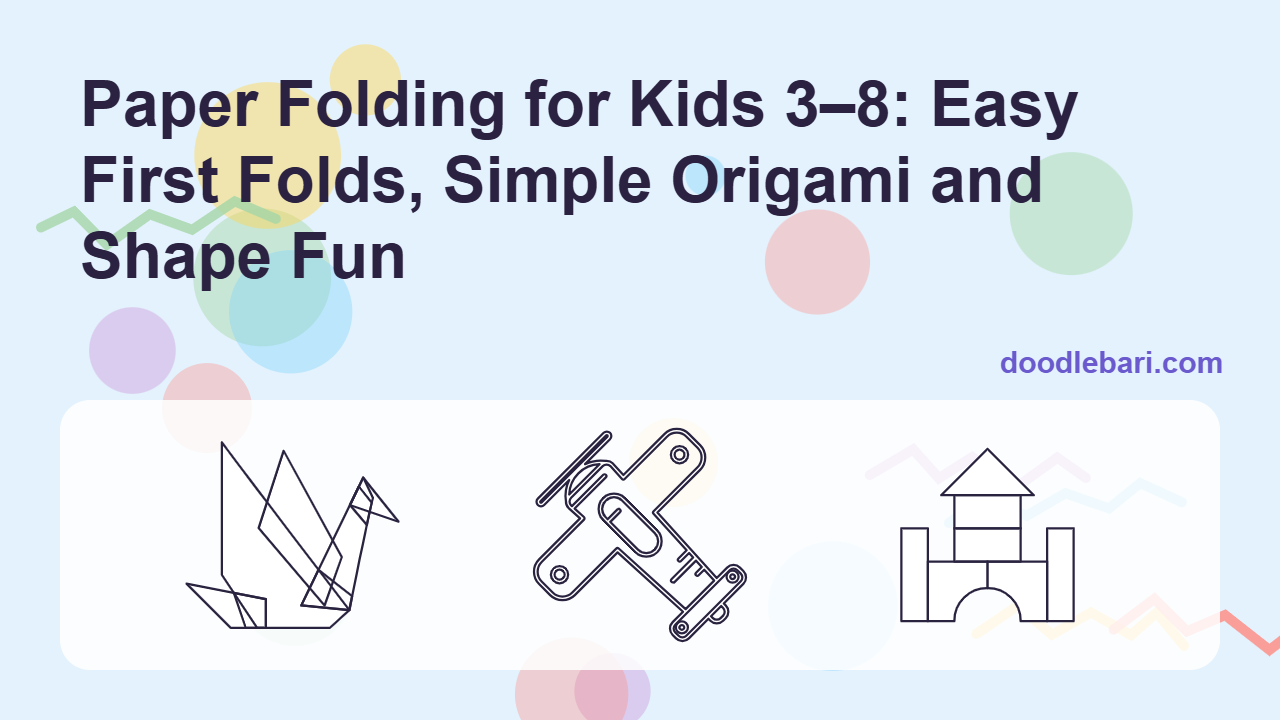
- Paper crane: harder, with many steps, but a great project for a patient eight-year-old working alongside an adult. It is fine if the first one looks rumpled.
- Paper plane: test different folds and measure which one flies furthest, which adds a little science.
At this age children can start to follow simple diagrams with arrows and dotted lines. Work through the first model together, then let them try the next one more independently.
Step-by-step tips for teaching folding
- Sit beside your child, not opposite. That way your hands move in the same direction as theirs.
- Use the same paper for both of you. Fold your square first, slowly, then wait while they copy.
- Name each step simply. "Corner to corner. Press. Open."
- Mark the corners. A small dot on the corners that need to meet helps beginners line them up.
- Fix problems kindly. If a fold is off, show how to open it and try again. Paper forgives.
- Stop before frustration. Two finished models are better than one tearful attempt at something too hard.
- Decorate at the end. Coloring the finished piece gives every child a successful finish, even if the folds were not perfect.
Linking folding to shapes and math
Paper folding is a wonderful way to talk about shapes and fractions without any worksheets:
- Fold a square in half: "Now we have two equal parts. Each part is a half."
- Fold again: "Four parts. Each part is a quarter."
- Ask: "Can we make a triangle from this rectangle?"
- Compare models: "Which boat is bigger? Which is taller?"
- Look for symmetry: when you open a folded sheet, both sides match.
Little ones aged 2–5 who are not ready to fold yet can still practise matching shapes to their outlines with Shapzoo's free shape puzzles, which is a nice way to include a younger sibling while an older child folds.
Making it a calm routine
Paper folding works well as a quiet activity after school, on rainy afternoons or before bed. Keep a small box with squares of paper, a few crayons and a finished model as an example. Children often return to it on their own once they know the first folds.
For groups and classrooms, try a "folding station" with one model per week, a step-by-step poster made from real folded paper glued in order, and a shelf to display finished work.
Frequently asked questions
Is origami too hard for a 3-year-old?
Real origami usually is, but simple folding is not. At three, aim for folding paper in half, making a fan and decorating a card. These build the skills that later make origami possible.
What paper is best for kids?
Medium-weight square paper around 15–20 cm is easiest. Printer paper cut into squares works well. Avoid thick card and very thin tissue paper for beginners.
My child gets frustrated when folds are not neat. How can I help?
Choose an easier project, use bigger paper and mark the corners that need to meet. Praise effort rather than neatness, and finish with coloring so every model ends with something your child is proud of.
How does paper folding help with writing?
Pinching, pressing and lining up edges use the same small hand muscles and hand-eye coordination that children later use for holding a pencil. It is one of many playful ways to strengthen little hands.
Fold, then color
Once your child has folded their first triangle, show them today's Paper Crane coloring page and talk about how a flat square becomes a bird. There are many more free coloring pages on Doodlebari to decorate next, and if you want the same pictures on a tablet for car rides, you can get the Doodlebari app from Google Play.